
If you received a gallery of beautiful professional photographs, does that mean you can print every image wherever you like? Not necessarily. Professional photography printing rights depend on the permission set out in your agreement, and receiving or purchasing digital files doesn’t automatically transfer copyright. It’s an easy distinction to miss when all you want is to hold a meaningful portrait in your hands.
You’re right to want clarity before ordering prints, sharing images, or creating gifts for family. Start by reviewing your signed agreement and any gallery terms it references. Look for the uses they permit, such as personal printing, and note any limits on editing, sharing, or commercial use. This guide explains who usually owns a professional photograph, how a print license or release may define personal use, and what to look for before sending files to a photo lab. Once you understand the permission, you can choose a lasting format, from an archival print to a canvas or album, and preserve the moments you love with greater confidence.
Key Takeaways
- Learn how professional photography printing rights differ from copyright ownership, and why the wording of your permission matters.
- Compare what a personal print license, print release, or written transfer may allow before reproducing or sharing an image.
- Review your signed agreement for terms such as “personal use,” “reproduction,” and “commercial use” before placing an order.
- Check separately whether your permission covers printing, gifting, social sharing, editing, or business use.
- Once you understand what’s permitted, choose a meaningful way to preserve a finished photograph, such as an archival print, canvas, or album.
What do professional photography printing rights actually mean?
Does receiving a digital gallery mean you can print the images? Not automatically. A gallery gives you access to image files, but permission to reproduce them depends on the terms attached to those files and the agreement you made with the photographer.
Copyright belongs to the person or entity that holds the photograph’s legal rights; a print license gives someone permission to reproduce that photograph for specific uses without necessarily transferring ownership. That distinction is the heart of professional photography printing rights. A license might cover personal prints, for example, while setting different rules for sharing, editing, or commercial use. The written agreement and applicable law determine what’s allowed, so don’t assume every photographer’s terms are the same.
Does paying a photographer mean you own the photographs?
Paying for a session or receiving finished images doesn’t, by itself, transfer copyright. In the United States, the photographer is generally the initial copyright owner of a photograph they create, though exceptions can apply. A written copyright transfer or a valid work-made-for-hire arrangement may change who owns the rights, and those legal details depend on the circumstances and wording.
Separate what you’ve paid for from what you’re permitted to do with the images. You may own the delivered digital copy or have access to a gallery while the photographer retains copyright. For broader context on how copyright and intellectual property can vary by jurisdiction, see Photography and the law.
What is a personal-use print release?
A personal-use print release is a type of permission that may let a client reproduce photographs for personal purposes without transferring copyright. Its scope depends on the actual terms. One agreement might allow prints for a household; another may specify whether gifts, albums, or personal social sharing are included. Restrictions on editing, commercial use, or other forms of reproduction may also apply.
Read the signed agreement and any gallery terms rather than relying on assumptions. A download button, invoice, or verbal understanding isn’t automatically a universal print release. Look for clear language about permitted uses and limits, and keep a copy of the terms with your image files. If a proposed use isn’t addressed clearly, don’t treat silence as broad permission. Get clear written authorization before reproducing or distributing the image.
Copyright, print releases, and image licenses: how do they differ?
These terms can appear side by side in a photography agreement, but they describe different kinds of rights. Copyright concerns ownership of the photograph; a license or release describes permission to use it. The label alone doesn’t tell you the full scope. Read the agreement to see which images, uses, and limits it actually covers.
A print license grants defined uses, not automatic ownership of the photograph. The table offers a general guide, not a substitute for the wording of your contract or legal advice.
| Term | Who holds rights? | What the client may do | What may remain restricted |
|---|---|---|---|
| Copyright | Generally, the photographer or another copyright holder | Use the images as permitted by a separate agreement | Reproduction, distribution, commercial use, or other rights not granted |
| Personal print license | The copyright holder keeps ownership | Make prints or display images for uses covered by the license | Uses beyond the stated scope, such as advertising or resale |
| Print release | Usually remains with the copyright holder | Reproduce images for the specific purposes described in the release | Any reproduction or use excluded by its terms |
| Written copyright transfer | May pass to the recipient if the transfer is valid and applies | Exercise rights described in the transfer | Rights not transferred and any applicable legal limits |
These categories are useful guides, not guarantees about a particular contract. “Print release” may describe different permissions, and a license might allow personal display while treating online sharing or commercial use separately. Sample language can help you recognize key terms, but it can’t determine what your own agreement means.
What might a personal print license allow?
If the agreement permits it, a personal print license may cover keepsake prints for your home or displaying an image in a family album. It may treat editing, resale, advertising, or other uses differently. Follow the exact wording rather than assuming that permission to print also allows you to alter, sell, or promote with the photograph.
How is a print release different from copyright transfer?
A release may authorize specified reproductions while leaving copyright with the photographer. A written transfer, by contrast, may assign copyright ownership, but the effect depends on the document and applicable legal rules. Because exceptions and contract language matter, have unclear or consequential terms reviewed by a qualified legal professional before relying on them.
Once you understand what your agreement permits, you can choose a fitting way to preserve the finished image, from an album to a wall display. Beautiful Capture Photography offers archival prints and museum-quality canvases as lasting formats for photographs that matter to you.
What can you print, share, or use from professional photos?
The same photograph can be covered by different permissions for different uses. Your agreement is the guide, so don’t assume that permission to make one personal print also covers posting, editing, gifting, or business promotion. Professional photography printing rights depend on the license you received.
- Personal printing: A license may allow prints for your home, but the agreement sets the scope, including any limits on copies or formats.
- Online sharing: Personal social media sharing may be allowed under some terms and restricted under others. Follow any conditions on where or how you share the image.
- Editing or cropping: Filters, retouching, and cropping may be restricted, even if you can share or print the original. Check before altering a finished photograph.
- Gifting: A print or album for a loved one may be permitted for personal use, but don’t assume that every license includes gifts or reproductions for others.
- Commercial use: Advertising, business promotion, and resale are distinct from personal use and may require separate authorization.
Giving the photographer credit can be courteous or required by the agreement, but attribution by itself doesn’t grant permission. Copyright exceptions such as fair use depend on the specific facts and context; they aren’t blanket approval for printing or sharing a photo. If an intended use isn’t clear in your terms, pause before using the image and get clarification in writing.
Can you print professional photos at a consumer photo lab?
It depends on both your license and the lab’s reproduction requirements. Having a digital file means you can access that copy; it doesn’t necessarily mean you have permission to reproduce it. Some labs may ask you to confirm that you’re authorized to make the prints, so read your agreement before placing an order and follow the lab’s stated process. Neither “you can always use any lab” nor “you can never use a consumer lab” is a reliable rule.
Can you post, edit, or use professional photos commercially?
Check each use separately. A license might allow personal social sharing but exclude a business website, advertisement, or product resale. Editing and cropping can also have their own restrictions. If you’re sharing an image online, follow the agreement’s attribution and platform terms, and don’t treat a credit line as a substitute for permission. For a use outside the written terms, get authorization before posting or reproducing the photograph.
How to check your photography agreement before ordering prints
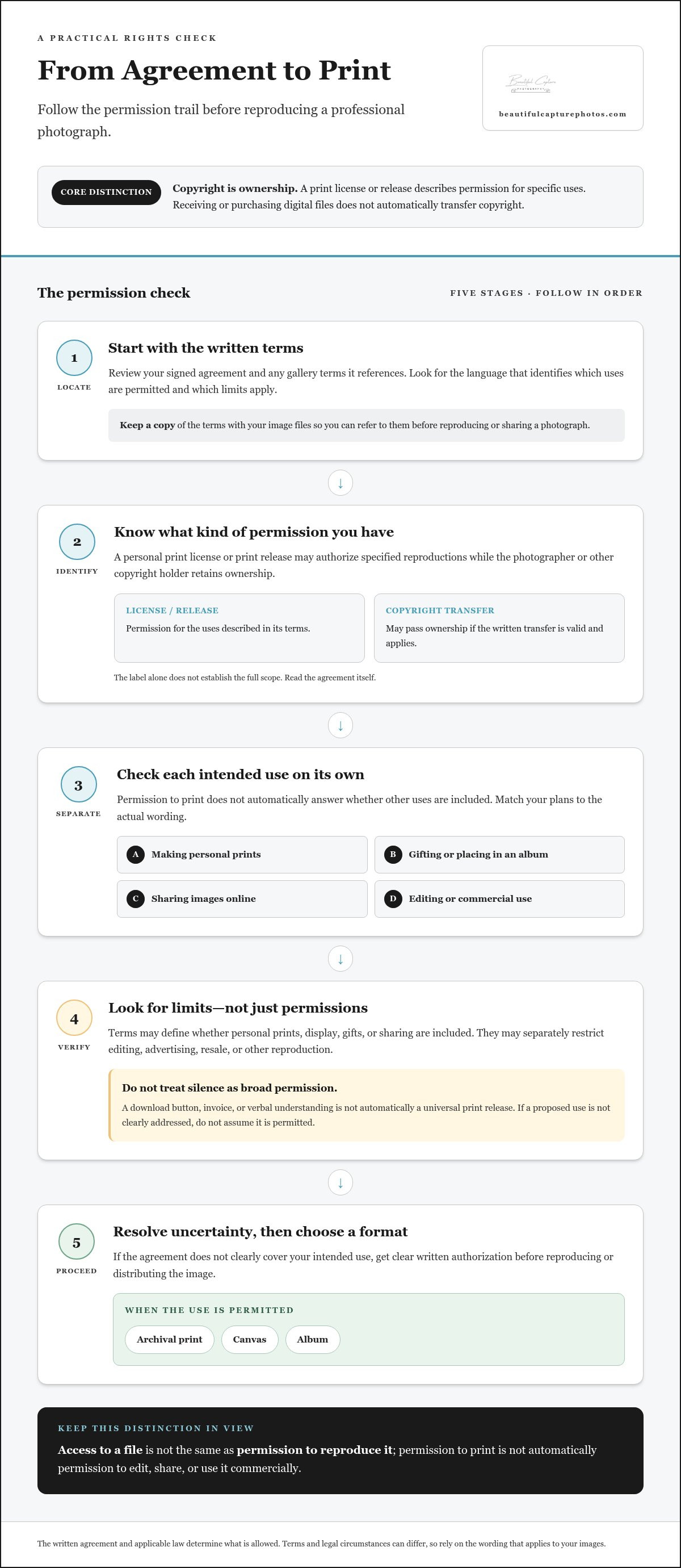
A few careful minutes with your paperwork can make the next step clearer. Use this process to understand the professional photography printing rights attached to your images, without treating general guidance as a legal interpretation of your individual contract.
- Locate the signed agreement. Check the contract and any addenda, then review the gallery or delivery terms it references. Keep related documents together so you’re reading the full set of conditions.
- Identify the license. Look for terms such as “personal use,” “reproduction,” and “print release.” Note who retains copyright and whether your permission is limited to certain purposes.
- Check the uses and formats. See whether the terms address print sizes or formats, albums, sharing, editing, publication, and commercial use. Permission for one use doesn’t necessarily cover another.
- Retain the terms. Save a copy of the agreement and any written permission alongside your finished image files. You can then refer to the exact language before placing an order or sharing an image.
If the wording is unclear, don’t assume it grants permission. Avoid relying on a template or interpreting a contract based on a single phrase. For questions with legal or financial consequences, consult a qualified legal professional. This guidance is educational, not a review of your specific agreement.
Which agreement details should you look for?
Check whether the agreement identifies the copyright holder and grants you a defined personal-use license. Scan for limits on printing, online sharing, editing, publication, and commercial use, along with any separate terms for delivered digital images, albums, or other physical products. Make a note of what each term applies to, especially if the agreement treats different formats or uses differently.
How can you plan a print that lasts?
Once you’ve confirmed that the intended reproduction is permitted, choose the finished image and display format that suit the memory and the space. Archival prints, canvases, and albums offer considered ways to bring photographs into everyday life, each with its own feel and place in the home. For help weighing physical formats, explore this professional photography products guide.
With permission understood and a format in mind, you can focus on the image you’ll be glad to see and revisit. Beautiful Capture Photography offers archival prints and canvases for preserving a favorite finished photograph.
Turn permitted professional photos into lasting prints
Once you’ve checked your professional photography printing rights, choose an image that feels at home in your life. Start with a finished photograph you’ll enjoy revisiting, then consider how you’d like to experience it: as a print to frame, a canvas for a favorite wall, or an album that brings a series of moments together.
Archival prints, museum-quality canvases, and custom albums offer different ways to preserve wedding, engagement, family, and special-occasion photographs in physical form. The best choice is personal. Think about the story you want to remember and where you’d like that memory to live, rather than choosing a format simply because it seems conventional.
Which kinds of photographs make meaningful keepsakes?
It might be a wedding portrait, a quiet exchange during an engagement session, a family gathering, or a candid moment from a celebration. A technically polished image can be lovely, but the photograph that makes you smile or brings back the feeling of the day may be the one you most want to keep close. Choose what matters to you.
For ideas on what makes wedding photographs feel personal and full of meaning, read this emotional wedding photography guide. Its perspective can help you look beyond a posed frame and notice the gestures, connections, and fleeting moments that carry your story.
What is a simple next step after checking your rights?
Revisit the agreement and match the permission to the format you have in mind. Then select a finished image and consider how it will fit into your home or become part of an album. A framed print can give one photograph a place of its own; a canvas can bring a favorite image into a room; an album can gather several memories into a story you can return to.
There’s no need to make the choice all at once. Begin with the photograph you feel drawn to, and let its meaning guide the format. Explore Beautiful Capture Photography’s finished print offerings for thoughtful ways to bring photographs into your home.
Make room for the photographs that matter
Before ordering prints, remember that receiving a digital image doesn’t automatically grant broad reproduction rights. Copyright and print permission are different, and your written agreement sets the scope of what you can print, share, or use. Review its terms first, especially if you’re considering a use beyond personal keepsakes.
Once permission is clear, choose a finished photograph that brings a moment back to life. A wedding celebration, an engagement, a family portrait, or a special occasion can take on a new presence as an archival-grade print, museum-quality canvas, or custom album. Understanding professional photography printing rights helps you make that choice with greater confidence, so the memories you value can be enjoyed in a form that feels personal.
Beautiful Capture Photography creates on-location images of weddings, engagements, portraits, and special occasions, with archival prints, museum-quality canvases, and albums to bring finished photographs into your home. Explore the work and print offerings of Beautiful Capture Photography to preserve a favorite moment. Serving clients in Raleigh, Durham, Chapel Hill, Cary, Morrisville, Carrboro, Mebane, Greensboro, High Point, and Winston-Salem, North Carolina.
Frequently Asked Questions
Do I own the copyright to photos I paid a professional photographer to take?
Generally, no. In the United States, the photographer is usually the initial copyright owner, even when you’ve paid for a session and received finished images. Your agreement may grant you permission to print or share photographs without transferring ownership. A written copyright transfer or a work-made-for-hire arrangement may change the outcome, but those depend on the document and circumstances. Review your signed agreement for the rights it actually grants.
Can I print professional photos I received in a digital gallery?
Possibly, but access to a gallery doesn’t automatically mean you have permission to reproduce every image. Check your contract and gallery terms for a personal-use license or print release, including any limits on formats or uses. Professional photography printing rights vary by agreement, so don’t assume that downloading a file gives you unrestricted permission. If the terms don’t clearly cover the print you want, don’t assume it’s allowed.
What does a professional photography print release allow?
A print release may authorize specific personal reproductions, such as prints for display or keepsakes, while leaving copyright with the photographer. The exact scope depends on its wording. It may address sharing, editing, copies, or other uses differently, and it doesn’t automatically permit advertising or resale. Read the release alongside your agreement, and follow its stated limits rather than treating the phrase “print release” as a universal set of permissions.
Can I print photographer photos at a different photo lab?
It depends on your license and the lab’s reproduction requirements. Some agreements allow personal printing through a lab of your choice; others may specify conditions or limit how images can be reproduced. Having the digital file isn’t the same as having permission to print it. Read your agreement before ordering, then follow the lab’s process for confirming authorization. Neither universal permission nor a blanket prohibition is a safe assumption.
Can I post professional photos on social media if I credit the photographer?
Credit alone doesn’t grant permission. Your agreement may allow personal social media sharing, set conditions for attribution, or restrict certain kinds of posting. Check the terms before uploading, including any directions about tagging or platform use. Also distinguish a personal post from using a photograph to promote a business, service, or product, since commercial use may require separate authorization. If the terms are unclear, don’t rely on a credit line as approval.
Can I edit or crop a professional photograph before printing it?
Check your agreement before changing the image. A license may allow you to print a finished photograph but restrict cropping, filters, retouching, or other edits. Even a small change can fall outside the permission granted, so don’t assume that print approval also covers alterations. If you want a different crop or adjustment, look for language addressing editing and reproduction, and get clear written authorization before using an altered version.
What should I do if my photography contract does not explain printing rights?
Review the full agreement and any gallery or delivery terms it references, then look for language about personal use, reproduction, or a print release. Don’t treat silence as broad permission. Before ordering or sharing, seek clear written authorization from the rights holder; for important or disputed questions, consult a qualified legal professional. Beautiful Capture Photography provides on-location photography in Raleigh, Durham, Chapel Hill, Cary, Morrisville, Carrboro, Mebane, Greensboro, High Point, and Winston-Salem.


