

What if your portraits could feel like you, without asking you to perform for the camera? It’s natural to worry that posing will feel stiff, or that “organic” photography simply means being left to figure it out on your own. Organic portrait sessions combine gentle photographer guidance with real movement, connection, and the ease of an on-location setting, so you can feel comfortable while moments unfold.
You don’t need to plan every smile or memorize a list of poses to feel prepared. A little thought about what matters to you can shape a personal session, while room for spontaneity leaves space for genuine expressions. In this article, you’ll learn what makes portraits feel authentic, how guidance and natural expression work together, and how to prepare without overplanning. We’ll also walk through what to expect during an on-location session and how to choose finished portraits, from archival prints to canvases and albums, that preserve meaningful moments and feel at home in your space.
Key Takeaways
- Organic portrait sessions prioritize genuine expression over repeating rigid poses, while still offering calm, helpful direction.
- Natural light, movement, and simple activities can help create a relaxed atmosphere without requiring you to perform for the camera.
- Prepare with a personal intention, comfortable clothing, and a little thought about the location, not a detailed pose-by-pose plan.
- Expect an on-location portrait experience shaped around you and your setting in Raleigh, Durham, Chapel Hill, and nearby communities.
- Preserve meaningful portraits as archival prints, canvases, or albums that feel at home in your space.
What Are Organic Portrait Sessions, and Why Do They Feel More Personal?
Organic portrait sessions are guided portrait experiences that make room for genuine expression and natural interaction instead of relying on rigid, repeated poses. “Organic” describes an approach, not a formal technical category or one fixed photography style. The photographer still shapes the experience, but direction is thoughtful and flexible, helping people feel at ease while the setting, connection, and small moments tell a personal story.
That balance matters. A portrait can feel relaxed without being accidental: the photographer considers what matters to you, offers simple guidance, and notices when a real expression or interaction emerges. The result is not about looking perfectly posed. It’s about seeing something recognizable in the people and relationships captured.
What makes a portrait feel organic rather than staged?
Comfortable movement and natural interaction give expressions room to develop. A couple might walk together and chat, or a family might pause to share a playful moment. The photographer can suggest where to stand or offer an activity, then watch for the laughter, affectionate glance, or quiet closeness that follows. These moments feel genuine because they grow from interaction, not because no one planned the session.
There’s intention behind the camera, even when a moment looks spontaneous. Helpful direction creates a comfortable starting point; observation helps preserve what feels true to you.
Why does an on-location setting change the experience?
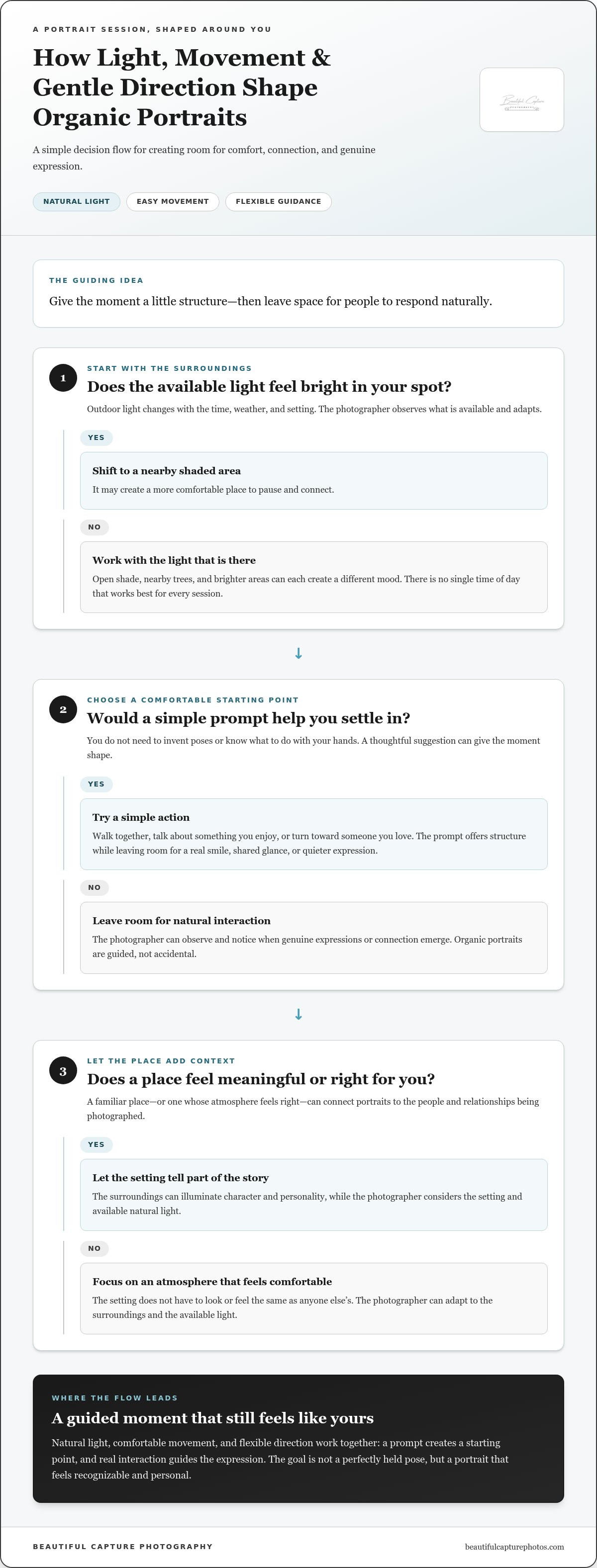
A familiar or meaningful place can add personal context to a portrait. It might be somewhere you enjoy spending time together or simply a setting whose atmosphere feels right. Photographers consider the surroundings and available natural light as they guide the session, making choices that support the mood without expecting every location to look or feel the same.
This connection between a person and their surroundings also appears in the idea of an environmental portrait, where the setting can help illuminate character and personality. On-location portraits bring that sense of context into the experience, rather than separating people from the places that matter to them. For more on choosing and using a setting, explore this on-location portrait session guide.
For individuals, couples, and families, a personal setting can ease the feeling of being in front of a camera. Beautiful Capture Photography offers on-location portrait sessions in Raleigh, Durham, Chapel Hill, Cary, Morrisville, Carrboro, Mebane, Greensboro, High Point, and Winston-Salem. Combined with gentle guidance, a meaningful setting helps create portraits that feel connected to your life, not just arranged for the photograph.
How Natural Light, Movement, and Gentle Direction Shape Organic Portraits
Light, movement, and guidance work together to make portraits feel at ease rather than overly arranged. Natural light can bring softness or shape to an image, but its effect depends on the surroundings and conditions. The photographer observes what’s available and adapts where people stand or how they move, instead of assuming one kind of light will look the same everywhere.
How does natural light contribute to a softer portrait?
Outdoor light changes with the time, weather, and setting. Open shade, nearby trees, or brighter areas can each create a different mood, and the photographer can use the available light to suit the people and place. There’s no single time of day that works best for every session; the setting and the feeling you’re hoping to capture help guide the approach.
For example, if light feels bright in one spot, shifting to a nearby shaded area may create a more comfortable place to pause and connect. It’s a practical adjustment, not a promise of identical results from one location or day to another.
What does gentle direction look like during a session?
Rather than asking you to hold a complicated pose, a photographer might invite you to walk together, talk about something you enjoy, or turn toward someone you love. These prompts give the moment a little structure while leaving space for a real smile, a shared glance, or a quieter expression to emerge. You don’t have to invent poses or know what to do with your hands; simple suggestions can help you settle into the experience.
Gentle direction gives a session shape while leaving room for genuine interaction to guide the expression in each portrait. That balance matters because feeling observed can make anyone self-conscious. The psychology of portrait photography offers useful context for why a subject’s comfort can influence how their personality comes through in an image.
In organic portrait sessions, the goal isn’t to eliminate guidance or capture every moment without intention. It’s to use a thoughtful prompt, then allow space for people to respond naturally. A couple might begin walking side by side and gradually forget about the camera as they talk. The photographer can notice that ease and capture it without interrupting the connection.
If you’re drawn to portraits shaped by natural surroundings and a personal, relaxed approach, you can explore on-location portrait sessions.
Organic Portrait Sessions vs. Rigid Posing: What Is the Difference?
Organic and more structured portrait approaches both involve choices about composition and direction. The difference is how much the moment is shaped in advance and how much room people have to move and respond naturally. A photographer can provide professional guidance in either approach; organic portraits simply leave more flexibility for expressions and interactions to develop.
| Element | Organic approach | More structured posing |
|---|---|---|
| Direction | Flexible prompts and adjustments as the session unfolds | Specific positions or instructions held for a planned image |
| Movement | Room to shift, interact, and move between moments | Movement is limited while a pose is set or repeated |
| Expressions | Expressions can emerge through conversation and connection | Expressions may be prompted or composed for a particular look |
| Session feel | Personal and responsive, with space for spontaneity | More planned, with clear structure from image to image |
Does organic portrait photography mean there are no poses?
No. A photographer may suggest where to stand, how to turn, or where to rest your hands, then adapt that guidance to your comfort. The difference is that a flexible prompt can lead into a moment, rather than asking you to hold one position the same way for every frame. You don’t have to invent poses or perform for the camera. Direction can change as the setting or your comfort changes.
For a family portrait, for instance, the photographer might first help everyone find a comfortable arrangement, then invite small adjustments as people connect with one another. The initial guidance gives the image shape, while the interaction brings individuality to the expressions.
Which portrait approach suits different people and moments?
Choose based on the feeling and purpose you have in mind, not on a rule that one method is better. Organic portrait sessions may suit people who value connection, movement, and a personal atmosphere. More structured posing can be useful when a portrait calls for a particular arrangement or consistent composition. A session can also include both: a few deliberately composed images alongside looser moments.
Neither approach guarantees a specific expression or result. The aim is to find a level of direction that feels comfortable and fits the people being photographed. If you feel unsure, sharing what you hope the portraits will express gives the photographer a helpful starting point.
How to Prepare for Organic Portrait Sessions Without Overplanning
A little preparation can help you feel ready without turning the session into a production. For organic portrait sessions, focus on a few useful choices, then leave room for the experience to unfold naturally.
- Choose a personal intention. Think about what you’d like your portraits to hold: warmth, playfulness, closeness, or another feeling that matters to you.
- Coordinate clothing. Choose comfortable pieces that let you move easily and still feel like yourself. Aim for outfits that work well together without making everyone look identical.
- Prepare for the location. Consider a setting that feels comfortable or meaningful and suits the mood you have in mind.
What should you decide before the session?
Start by picturing how you hope the finished portraits will feel, and where you might enjoy displaying them. A favorite print at home may call for a different mood than an album meant to tell a family story. You don’t need a detailed shot list; a simple intention gives the photographer helpful context while leaving creative room for genuine moments.
Think about a location that supports that feeling. A familiar place may help you settle in, while another meaningful setting can add a sense of connection to the photographs. For broader ideas about planning the day, read this professional photography session guide.
How can you stay present once the session begins?
Once you arrive, try to focus on the people with you rather than checking every expression or wondering what your hands are doing. Talk, walk, share a small joke, or take a quiet pause together. Those simple interactions give the photographer genuine moments to notice, and a pause doesn’t mean anything has gone wrong. It’s part of having room to settle into the experience.
Your photographer can offer direction as needed, so you don’t have to rehearse smiles or remember a sequence of poses. If something feels uncomfortable, say so; guidance can be adjusted to suit you. Preparation is there to make the session feel more personal, not to give you a performance to deliver.
With a clear intention, comfortable clothing, and a location that feels right, you can arrive ready without planning every detail. Explore an on-location portrait session and begin shaping an experience around what matters to you.
What to Expect from Organic Portrait Sessions in Raleigh and the Triangle
An on-location portrait session is shaped around you, the people you’re with, and the setting you choose. For clients in Raleigh, Durham, Chapel Hill, and nearby communities, that means the experience can reflect a place that feels comfortable or meaningful, rather than a generic backdrop. Beautiful Capture Photography provides on-location portrait sessions across Raleigh, Durham, Chapel Hill, Cary, Morrisville, Carrboro, Mebane, Greensboro, High Point, and Winston-Salem. Your photographer offers calm direction while paying attention to the setting and the interactions that make the portraits feel personal.
There’s no single way a session should look. An individual portrait can focus on personality and self-expression, while a couple may want images that bring their connection to the foreground. Family portraits can include everyone looking toward the camera, but they can also make room for the small exchanges that show how family members relate to one another.
How can a session reflect different relationships and personalities?
For an individual, gentle prompts can help create a portrait that feels at ease without asking you to adopt a different persona. In a couple’s session, walking together or sharing a conversation can give the photographer a chance to capture connection as it naturally shows. With families, a mix of togetherness and interaction can reveal more than one formal arrangement alone.
These are possibilities, not a script. Your priorities help shape the experience, and the photographer can adapt the direction to the people in front of the camera. For more ideas focused on family portraits, see this family portrait photography guide.
How can finished portraits become part of everyday life?
After the session, consider how you’d like to revisit the photographs. Archival prints, museum-quality canvases, and albums offer physical ways to keep selected images close. A print or canvas can bring a favorite moment into a room, while an album can gather several images into a story you can return to together.
Let your intention guide the choice: think about which moments you’d enjoy seeing in your home, and whether you’re drawn to one expressive portrait or a collection that reflects a relationship over time. The goal is to choose a form that feels meaningful to you, without needing to decide everything before the session.
With a setting and experience shaped around your story, the next step can be simple. Explore an on-location portrait session and begin imagining portraits that feel personal to you.
Let Your Portraits Feel Like You
Authentic portraits don’t require you to feel perfectly posed or plan every moment. Organic portrait sessions combine thoughtful photographer guidance with room for natural expression, movement, and connection. A little preparation, such as choosing a meaningful setting and clothing that feels comfortable, can help you arrive ready without turning the experience into a performance.
On-location portrait sessions for individuals, couples, and families are shaped around the people and setting. Once you’ve chosen your favorite images, archival prints, museum-quality canvases, and albums offer tangible ways to bring those memories into your home and revisit them over time.
If you’re ready to create portraits that reflect your relationships and the moments you want to remember, explore on-location portrait sessions. Beautiful Capture Photography offers portrait sessions in Raleigh, Durham, Chapel Hill, Cary, Morrisville, Carrboro, Mebane, Greensboro, High Point, and Winston-Salem. Begin shaping an experience around what matters to you.
Frequently Asked Questions
What are organic portrait sessions?
Organic portrait sessions are portraits shaped around genuine expression and interaction rather than a series of rigid, repeated poses. “Organic” describes an approach, not a fixed technical category. The photographer still provides direction, but leaves room for natural movement and connection. An on-location setting can also add personal context, helping the finished portraits reflect the people, relationships, and surroundings that matter to you.
Do organic portrait sessions include posing?
Yes. Your photographer can suggest simple positions or adjustments, such as where to stand or how to turn, without asking you to hold the same pose throughout the session. Flexible prompts offer structure while allowing expressions to develop naturally. You don’t have to invent poses or know what to do in front of the camera. Direction can adapt to your comfort and the moment.
Can you have natural-looking portraits if you feel awkward in front of a camera?
Yes. Feeling camera-shy doesn’t mean you can’t have portraits that feel like you. A photographer can offer gentle prompts, such as walking or talking with someone you love, so you have something natural to focus on instead of monitoring every expression. Small pauses are okay, too. The aim is to guide the experience without expecting you to perform or produce a perfect expression on demand.
What should I wear for an organic portrait session?
Choose clothing that feels like you, is comfortable to move in, and suits the setting. If you’re coordinating outfits with a partner or family, look for colors and textures that work together without making everyone match exactly. Consider how the clothing supports the mood you want in the portraits, whether that’s relaxed, polished, or playful. Comfort helps you move and interact naturally during the session.
Where do organic portrait sessions take place?
Beautiful Capture Photography’s portrait sessions take place on location, not in a studio. The setting can be chosen to feel comfortable, meaningful, or suited to the mood you have in mind. Sessions are available in Raleigh, Durham, Chapel Hill, Cary, Morrisville, Carrboro, Mebane, Greensboro, High Point, and Winston-Salem, North Carolina.
How do organic portrait sessions differ from candid photography?
Organic portraits include intention and photographer guidance, while still making room for natural interaction and expression. Candid photography often describes images made while people are focused on an activity rather than directly engaging with the camera. The approaches can overlap, but an organic session isn’t simply unplanned photography. The photographer helps shape the experience and setting, then responds to the genuine moments that unfold.


