
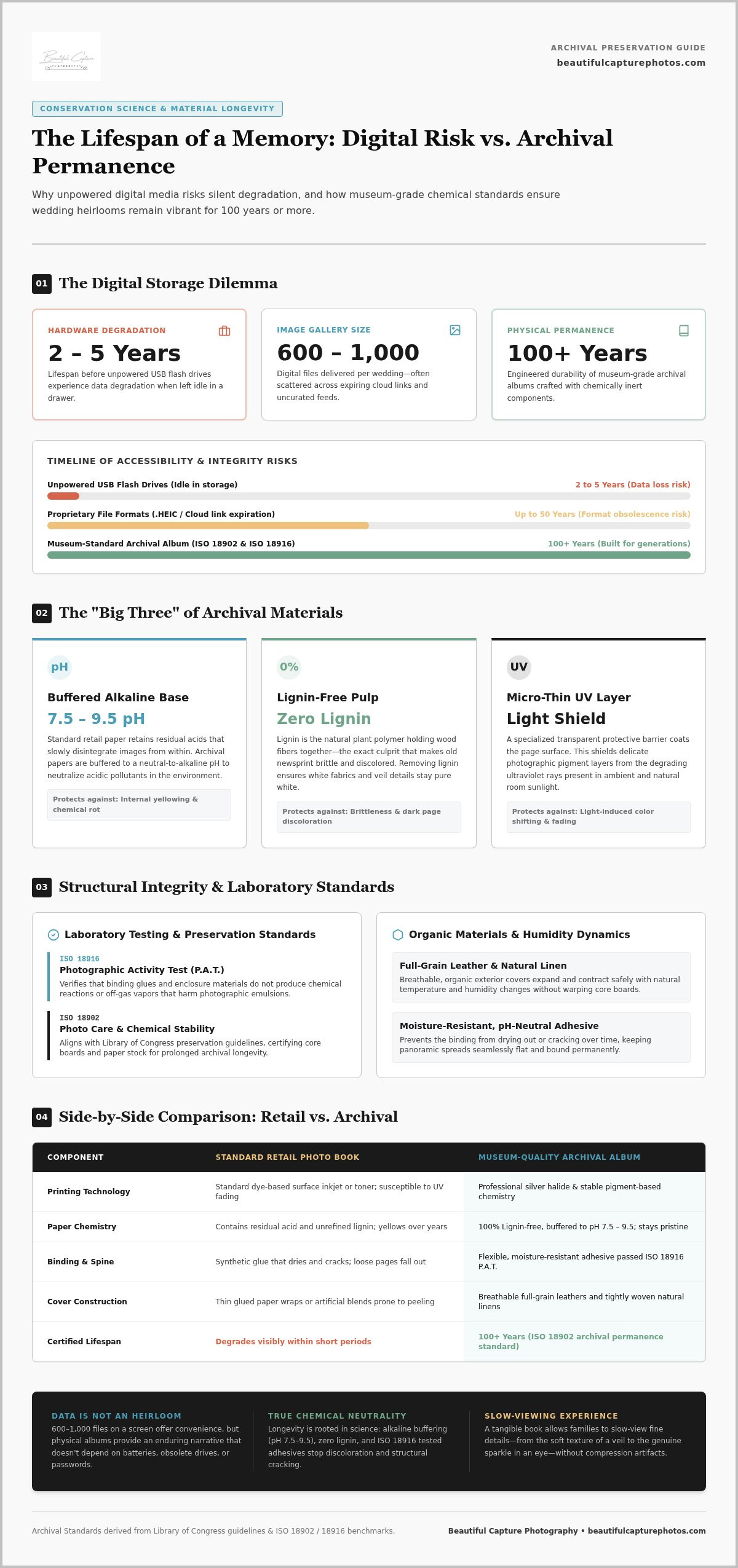
Unpowered USB flash drives can experience data degradation within just two to five years if they're left idle in a desk drawer. While we've often been told that digital is forever, the reality is that hardware fails and cloud links eventually expire, leaving many couples feeling anxious that their most precious memories might simply vanish. It's natural to feel overwhelmed by a gallery of a thousand images, and even more confusing to decipher technical terms like "acid-free" or "lignin-free" when you just want a beautiful way to remember your day. You deserve the quiet confidence that your story is safe.
We believe your wedding day deserves more than a temporary home on a screen. This guide will show you how archival wedding albums transform your favorite moments into a durable, museum-quality heirloom that's built to last for generations. You'll discover how professional craftsmanship and specialized materials ensure your book remains a vibrant piece of art for 100 years or more. We'll explore the science behind preservation and the gentle, expert-led process that makes creating your family legacy feel completely effortless and joyful.
Key Takeaways
- Understand why digital storage is often temporary and how a physical heirloom provides a permanent, reliable anchor for your most precious memories.
- Learn the science behind archival wedding albums, including why pH-neutral and acid-free materials are essential for preventing yellowing or decay.
- Discover the critical difference between standard retail photo books and professional silver halide printing to ensure your images never lose their vibrant detail.
- Find out how a curated design process simplifies your choices by turning a massive digital gallery into a focused and artistic narrative.
- See how a guided, stress-free approach takes the burden of decision-making off your shoulders so you can simply enjoy the final, tactile result.
The Digital Dilemma: Why Your Wedding Memories Need an Archival Home
It's a beautiful irony of our modern age; we capture more moments than any generation before us, yet we're at the highest risk of losing them. Most couples receive a gallery of 600 to 1,000 digital images after their wedding. It feels like a wealth of memories, but without a physical home, those files are often tucked away on a USB drive or a cloud server. Hardware fails, and cloud subscriptions can expire quietly in the background. A digital file isn't a finished product; it's a set of data waiting for a screen to interpret it. Archival wedding albums offer a different path, providing a permanent anchor that doesn't rely on a battery or a software update.
Digital Obsolescence vs. Physical Permanence
In 2026, digital files serve as a temporary storage solution because technology moves at a speed that quickly leaves older formats behind. Think about the social media platforms where we often share our highlights. Those sites use heavy compression that strips away the fine details of your high-resolution memories, leaving you with a low-quality version of your best day. There's also the "found in the attic" factor to consider. While a book can be picked up and read by anyone, we can't be certain that your grandkids will have the tools to open a .HEIC file or a cloud link in fifty years. By leaning on the principles of photographic conservation and restoration, we ensure your story remains accessible without needing a tech expert to unlock it.
The Tactile Experience of a Professional Heirloom
There is a profound psychological benefit to slow-viewing your wedding story. When you sit down with a heavy, professional book, your brain processes the narrative differently than it does when you're scrolling through a phone. Large-format prints in an album reveal the soft texture of your veil or the genuine sparkle in your partner's eyes, details that are often lost on a small screen. A physical book becomes a natural centerpiece for family gatherings in your North Carolina home. Whether you're in Raleigh or Chapel Hill, having a tangible heirloom on your coffee table invites guests to linger over the images. It transforms your wedding from a sequence of data points into a curated narrative that feels like a piece of art.
Defining Archival Quality: The Science Behind 100-Year Albums
When we talk about "archival" quality, we aren't just using a fancy marketing term. It describes a specific standard of chemical stability where materials are designed to resist deterioration over centuries. For archival wedding albums, this means every component, from the core boards to the ink, must pass rigorous testing. Following the Library of Congress guidelines for photo care, we look for materials that meet ISO 18902 standards to ensure your memories don't just survive but thrive. This level of care ensures that your investment remains as vibrant as the day you said your vows.
The 'Big Three' of Archival Materials
Most retail papers contain residual acids that slowly eat away at an image from the inside out. Archival pages are buffered to a neutral or slightly alkaline pH, typically between 7.5 and 9.5, to neutralize environmental pollutants. Lignin is the organic polymer that holds wood fibers together, and it is the primary reason old newspapers turn brittle and yellow. By ensuring your album paper is lignin-free, your white wedding dress stays crisp and bright for decades. Finally, professional albums often include a micro-thin UV protective layer. This shield is especially important if you enjoy flipping through your book in the bright, natural light of a North Carolina afternoon.
Structural Integrity: Beyond the Paper
The chemistry of the cover and binding is just as vital as the pages. Standard glues often dry out and crack, causing pages to fall out within a short time. We use pH-neutral, moisture-resistant adhesives that have cleared the ISO 18916 Photographic Activity Test. This ensures the bond remains flexible and strong without off-gassing harmful chemicals. Using breathable, organic materials like natural linens and full-grain leathers allows the book to expand and contract naturally with changes in humidity. Museum-quality prints achieve their legendary longevity through the use of stable pigment-based inks that resist fading far better than standard dyes. If you're ready to see how these fine materials feel in person, you can explore our archival prints and albums during a personalized consultation.
Professional vs. Retail: Why Standard Photo Books Fade
It's easy to be tempted by the convenience and low price of mass-market photo books. They're quick to assemble and arrive in the mail just a few days later. However, there's a significant technical gap between a retail book and a professional heirloom. Most consumer services use "Press-Print" technology, which is essentially the same process used for magazines or brochures. These books use tiny dots of CMYK ink that sit on the surface of the paper, making them highly susceptible to fading, scratching, and color shifts over time. When you're looking to preserve a legacy, these standard options often fall short of the mark.
The Printing Process Comparison
Professional archival wedding albums utilize Silver Halide printing, which is a photochemical process where the image is actually embedded within the paper. This creates a continuous tone without visible dots, resulting in much smoother gradients and deeper, richer blacks. If you've ever noticed that your photographer's beautiful edits look "off" or muddy in a cheap book, it's likely because the retail printer's color gamut is too narrow to reproduce the original vibrancy of the session. You can learn more about these technical standards in our guide on Museum Quality Photo Prints: Archival Guide for Your Home.
Durability and Construction
The physical structure of a book is just as important as the ink used to print it. Retail books often use "gutter binding," where the pages are glued into a central crevice. This means you lose a portion of your photo in the fold, which is a major design failure for those wide, panoramic shots of your ceremony. In contrast, professional albums feature layflat binding. This allows the book to open perfectly flat, showcasing your images across a seamless spread without a gap in the middle. We also focus on reinforced spines that are built to be opened thousands of times without cracking or losing their shape.
According to NEDCC's photograph preservation guidelines, the use of acidic adhesives and non-archival mounting surfaces in standard books can cause permanent chemical damage to your prints. Professional construction avoids these pitfalls by using pH-neutral materials and heavy, rigid pages that won't warp or tear with regular use. For a deeper look at what to look for when investing in your memories, check out our Choosing Professional Photography Products: The Archival Quality Buying Guide. This structural integrity ensures your album feels like a substantial piece of art every time you hold it in your hands.
Designing Your Legacy: Customization and Care
Designing your legacy is where the science of preservation meets your personal aesthetic. While the internal chemistry ensures longevity, the outward design makes the book a true reflection of your wedding day. Choosing between cover materials is often the first step in this creative journey. Natural linens offer a soft, organic texture that feels wonderful in the hand, making them a popular choice for light-filled, garden ceremonies. In contrast, genuine leathers provide a substantial, timeless durability that feels like a classic heirloom. Both options are chosen for their ability to protect the archival wedding albums within while complementing your home's unique style.
The selection of images is just as vital as the materials themselves. We often encourage couples to embrace the art of curation. Rather than crowding pages with dozens of small photos, using fewer, larger images creates a more powerful emotional impact. This allows the most significant moments, like the quiet glance before the ceremony or the joy of the first dance, to take center stage as a cohesive narrative. It's about telling the story of your day with intention and grace.
Aesthetic Choices for Your Home
Your album should feel like a natural extension of your living space. Whether you're decorating a modern home in Raleigh or a traditional space in Cary, selecting cover colors that harmonize with your interior design ensures the book remains a cherished centerpiece. Subtle touches like blind debossing or foil stamping add a layer of sophisticated personalization without overwhelming the design. If you're also considering how to display your memories on your walls, you might find our guide on How to Choose Custom Canvas Wall Art: The Ultimate Archival Quality Guide (2026) helpful for creating a consistent look throughout your home.
Caring for Your Album in North Carolina
The local climate in the Research Triangle presents unique challenges for physical media. High humidity is a primary concern for any paper-based heirloom. To keep your album in peak condition, it should never be stored in a basement or an attic where moisture and temperature fluctuate wildly. Ideally, your book should live in a climate-controlled room kept between 60 and 70 degrees with a relative humidity of 30 to 50 percent. This "comfort zone" prevents the paper from warping and protects the stability of the inks.
Proper handling is the final piece of the preservation puzzle. The natural oils and salts on our skin can transfer to the pages over time, potentially affecting the delicate emulsion of your prints. We recommend always handling your album with freshly washed, dry hands, or even using a pair of white cotton archival gloves for those special viewing sessions. By following these simple steps, you ensure your investment remains pristine for decades to come. If you're ready to start selecting the perfect materials for your own story, you can browse our full range of archival prints and albums today.
The Beautiful Capture Experience: From Session to Heirloom
At Beautiful Capture Photography, we believe that a professional photography session isn't truly complete until your memories have a physical home. Our philosophy is rooted in the idea that digital files, while convenient for quick sharing, are simply the first step in a much larger journey. The true end goal is a finished, tangible piece of art that you can hold, share, and pass down. By focusing on the final product from the very beginning, we ensure that every shot is taken with your future legacy in mind. This commitment to the "finished product" is what sets our experience apart and transforms a simple gallery into a lifelong treasure.
Every one of our archival wedding albums undergoes a rigorous quality check to ensure museum-grade perfection. We inspect the clarity of the prints, the strength of the binding, and the texture of the cover materials before the book ever reaches your hands. This attention to detail extends beyond the album itself. Many of our clients choose to coordinate their books with our Museum-Quality Canvases or archival prints, creating a cohesive aesthetic throughout their home. It's a seamless way to surround yourself with the moments that matter most, ensuring your interior design feels as intentional as your wedding day.
Our Guided Curation Process
One of the biggest hurdles couples face is "digital overwhelm," the daunting task of sorting through 800 or more images to find the ones that best tell their story. We take this burden off your shoulders through our guided curation process. Instead of leaving you to navigate a massive gallery alone, we act as your calm curator, helping you narrow down your collection into a 40-page masterpiece. This collaborative phase allows you to see a digital mock-up of your layout before it ever goes to print. By focusing on emotional wedding photography, we ensure the narrative flow of your book captures the unscripted, genuine moments that define your relationship.
Your Local Raleigh Photography Partner
As your local Raleigh photography partner, we're here to guide you through every stage of this process, from the first click of the shutter to the final delivery of your heirloom. We understand the unique vision you have for your North Carolina wedding, and we're committed to making the design phase just as joyful as the day itself. Once your gallery is ready, we'll schedule a post-wedding consultation to begin your album design together. We're not just taking pictures; we're building a bridge between your present joy and your future family history. Ready to preserve your story? Contact Beautiful Capture Photography to start your archival journey.
Begin Your Legacy Today
Your wedding day is one of the most significant chapters in your family's history. While digital files offer a quick way to share highlights, they don't provide the lasting security your memories deserve. By choosing archival wedding albums, you're investing in a piece of art that resists the passage of time through stable chemistry and superior craftsmanship. You've learned how silver halide printing and acid-free materials prevent the fading and yellowing that plague standard photo books. Now, it's time to transform those digital pixels into a tactile heirloom you can feel proud to display.
We're here to make the transition from a screen to a physical book completely effortless. With our local Raleigh-Durham expertise and a custom design service that handles the curation for you, you can relax knowing every detail is being managed by a professional. We guarantee museum-quality materials that will protect your story for a century or more. Don't let your favorite moments stay hidden on a hard drive. Design Your Family Heirloom with Beautiful Capture Photography and give your legacy the beautiful home it deserves. We can't wait to help you create something timeless.
Frequently Asked Questions
What makes an album 'archival' compared to a standard photo book?
An archival album is defined by its chemical stability and structural integrity. Unlike retail books that use surface-level ink dots, professional archival wedding albums use silver halide technology where the image is actually embedded within the paper. The materials are strictly acid-free and lignin-free, preventing the yellowing and brittle texture found in standard wood-pulp papers. This ensures that the book doesn't just hold your photos but protects them from internal decay over many decades.
How long do archival wedding albums actually last?
When stored correctly, these albums are designed to last for 100 to 300 years. Research indicates that archival pigment and silver halide prints have exceptional dark storage stability, far exceeding the 15 to 30 year lifespan of standard commercial press prints. By choosing museum-grade materials, you're ensuring that your great-grandchildren can still see the vibrant colors and fine details of your wedding day exactly as they appeared during your celebration in 2026.
Is it better to get a leather or linen cover for long-term preservation?
Both leather and linen are excellent choices for long-term preservation because they are natural, breathable materials. Genuine leather is often favored for its timeless durability and resistance to wear over decades of handling. Linen provides a beautiful, organic texture that is equally stable when kept in a climate-controlled environment. The most important factor is the archival quality of the binding and adhesives used underneath the cover, which we guarantee for every heirloom we create.
Can I add more pages to my archival album later?
No, additional pages cannot be added once the album has been hand-bound and finished. Because professional albums use a specialized flush-mount binding process where pages are mounted to rigid core boards, the spine is custom-built for a specific number of spreads. We work closely with you during the design phase to ensure every anchor moment is included. This permanent construction is exactly what gives the book its strength and allows it to lie perfectly flat.
How should I store my wedding album to prevent damage in North Carolina's humidity?
You should store your album flat in a climate-controlled room within your North Carolina home. Places like Raleigh and Durham experience high humidity, which can lead to page warping if the book is kept in a basement or attic. Aim for a comfort zone of 60 to 70 degrees Fahrenheit and 30 to 50 percent relative humidity. Storing the book horizontally rather than vertically also prevents the heavy, rigid pages from putting undue stress on the spine.
Why don't you provide raw files along with the archival album?
We believe that a finished, archival product is the true end goal of professional photography. Raw image files are unfinished data sets that require specialized software to view and edit correctly. Our process focuses on delivering a curated, polished narrative that is ready to be enjoyed and preserved. By providing a museum-quality album rather than raw files, we take the burden of technical management off your shoulders and deliver a legacy item that is already perfect.
Do you offer archival albums for engagement or family portrait sessions too?
Yes, we believe every significant life chapter deserves a permanent home. While we specialize in weddings, we also offer archival wedding albums and smaller heirloom books for engagement sessions and family portraits. Whether you're documenting your first year as a couple or a multi-generational gathering in Chapel Hill, the same museum-grade standards apply. Every session we lead is designed to result in a tangible product that brings joy to your daily life and family history.
How many photos should I include in a professional wedding album?
We generally recommend including between 60 and 100 photos to tell a cohesive, impactful story. While it's tempting to include every image from your session, a curated selection allows the most emotional moments to breathe. Using fewer, larger images on a spread creates a sophisticated, artistic feel that honors the importance of the event. Our stress-free design process helps you narrow down your favorites, ensuring the final book feels like a masterpiece rather than a crowded digital gallery.


