
What if the vibrant smiles and golden sunlight captured in your favorite family portraits began to dim before your children even left for college? It's a quiet fear many parents share, the worry that the physical records of our most joyful days might eventually fade into a blurred memory. You've likely felt the frustration of seeing a standard retail print lose its depth or turn an unnatural shade of yellow after just a few years on the wall. You want your home to reflect the beauty of your life with clarity and grace, but the search for true museum quality photo prints often feels buried under technical jargon that's more confusing than helpful.
You deserve to feel a deep sense of peace knowing your legacy is protected. This guide will show you how archival standards transform simple images into generational heirlooms that remain as vivid as the day they were taken. We'll walk through the technical requirements of acid-free materials and the aesthetic benefits of high-end finishes. By the end, you'll have the confidence to curate a professional home gallery that feels both timeless and deeply personal.
Key Takeaways
- Understand the specific technical standards that transform a simple photograph into a lasting heirloom with a lifespan measured in centuries rather than years.
- Learn why pigment-based inks and acid-free papers are essential components of museum quality photo prints to ensure your colors stay as vibrant as the day they were captured.
- Identify the hidden differences between professional archival materials and standard retail prints to avoid the common heartbreak of fading and yellowing.
- Discover how to protect your precious wall art from the unique light and humidity challenges found in the Raleigh and Durham climate.
- Gain the confidence to curate a professional home gallery that reflects your family's story with both technical excellence and emotional depth.
What Defines a Museum Quality Photo Print?
The word "quality" is used so often in marketing that it sometimes loses its meaning. When we speak about museum quality photo prints, we aren't just describing a pretty picture or a glossy finish. We're talking about a rigorous technical standard rooted in material science and preservation. While many retail labs promise professional results, a true museum-grade print is designed to meet the same strict stability and longevity requirements as the art found in the Library of Congress. It's a commitment to color accuracy and structural integrity that ensures your family's story doesn't just look good today, but remains unchanged for a century.
It is helpful to understand that "professional" and "museum quality" are not always interchangeable terms. A professional print might look stunning when you first unwrap it, but it may still use materials that are prone to fading over time. Museum-grade standards require that every component, from the base fibers of the paper to the chemical makeup of the ink, is chemically stable. This level of care creates a physical hedge against the fragility of digital life. Hard drives fail and cloud subscriptions expire, but a tangible, archival piece of art remains a constant presence in your home.
The 100-Year Promise: Longevity and Legacy
Think about the digital files currently sitting on your phone or a dusty hard drive. Technology changes fast, and files can easily become corrupted or lost in a cloud migration. A physical, archival print acts as a bridge to the future. These prints are crafted to last 100 years or more when displayed under normal home conditions. It's about creating a legacy that survives the rapid pace of digital obsolescence. When you hold a physical heirloom, you're giving your grandchildren a connection to their past that doesn't require a password or a specific software update to access.
The Elements of Archival Excellence
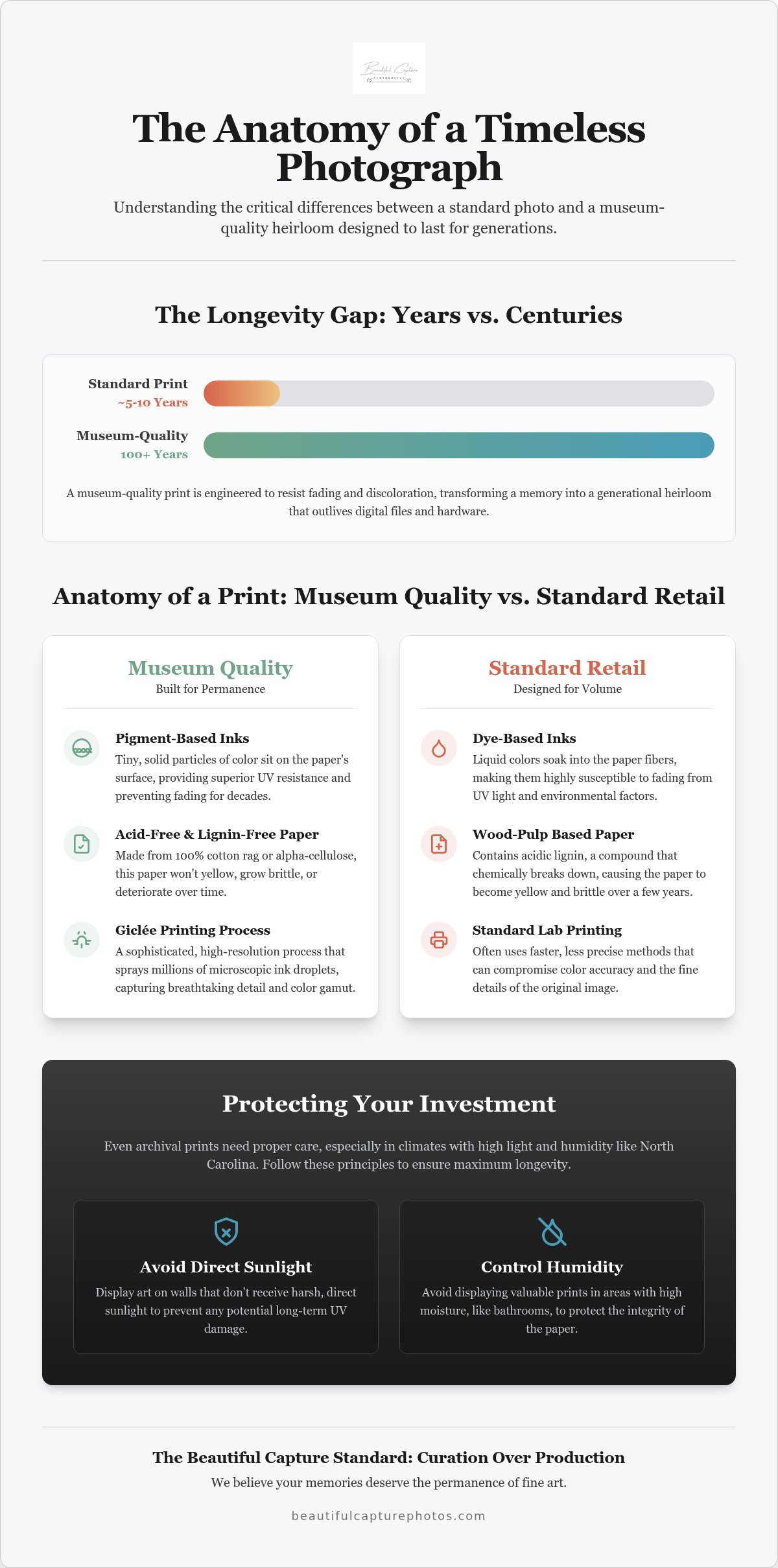
Achieving this level of permanence requires a harmony between three specific pillars: the paper, the ink, and the printing process itself. If one element is weak, the entire piece is at risk of fading or yellowing. According to the ASTM D3290 standard, archival quality refers to the ability of a material to retain its original characteristics and resist deterioration over an extended period of time under specified storage conditions. We look for specific combinations that work together to protect your memories:
- Acid-free media: Using 100% cotton rag or alpha-cellulose papers ensures the base won't become brittle or discolored.
- Pigment-based inks: These offer superior lightfastness and color stability compared to common dyes used in standard retail machines.
- Precise chemistry: A controlled process where the ink bonds perfectly with the paper's receiving layer for maximum durability.
This careful curation is what separates a fleeting snapshot from a piece of fine art that feels both timeless and deeply personal.
The Technical Anatomy: Giclée, Pigments, and Acid-Free Media
The term Giclée often feels like a bit of a mystery. It is a French word that simply means "to spray," yet it represents the gold standard for museum quality photo prints. Unlike the quick prints you might find at a local retail shop, Giclée printing uses sophisticated inkjet technology to lay down millions of microscopic droplets with incredible precision. This process creates a depth of color and a level of detail that standard machines simply cannot match. It’s the difference between a fleeting snapshot and a piece of art that feels alive on your wall. When you choose this method, you're investing in a process that respects the delicate nuances of light and shadow captured during your session.
Pigment Inks: The Secret to Vivid Longevity
Why do some photos keep their glow while others turn gray? The answer often lies in the ink. Most retail printers use dye-based inks, which are essentially liquid colors that soak into the paper. While they look bright at first, they're highly sensitive to light and air. In contrast, archival prints use pigment-based inks. These are composed of tiny, solid particles of color that sit on the surface of the paper, much like fine oil paint. Because these particles are naturally resistant to UV rays, they maintain a "just-printed" look for decades. This technology allows for a much wider color gamut. It captures the subtle golden hues of a sunset or the soft textures of a child’s hair with breathtaking accuracy.
Acid-Free and Lignin-Free Media
The paper itself is just as vital as the ink it holds. Have you ever noticed how old newspapers become yellow and brittle? That is caused by lignin, a natural component of wood pulp that turns acidic over time. True museum-grade papers are made from 100% cotton rag or alpha-cellulose, which are naturally lignin-free and pH-neutral. We also look for papers that avoid Optical Brightening Agents (OBAs). While OBAs make paper look "extra white" initially, they eventually break down and leave the print looking dull and yellowed. Choosing a matte or luster finish on acid-free media ensures your memories remain vibrant without the risk of structural decay. If you're feeling overwhelmed by these technical choices, we often help families select the perfect archival prints and albums to suit their unique home decor and aesthetic vision.
By combining these three elements, you create a physical object that is built to last. It's a thoughtful way to ensure that the moments you cherish today are still there to be enjoyed by the next generation, standing strong against the passage of time and the elements of your home environment.
Museum Quality vs. Retail Prints: The Longevity Gap
It’s tempting to head to a local big-box store for a quick print. At first, the results might look acceptable. However, standard retail prints, whether they are silver halide or basic inkjet, are built for speed and low cost rather than endurance. Within five to ten years, you may notice the "Yellowing Factor" taking hold. This happens because the chemicals in the paper and the dyes in the ink react to the air around them, causing the image to lose its crispness. Museum quality photo prints avoid this heartbreak by using materials that remain chemically inert, keeping your whites bright and your colors true for a lifetime.
Have you ever looked at an old family photo and wondered why everyone looks a bit sickly, or why a white wedding dress has taken on a strange greenish tint? This is called color shifting. It occurs when one type of dye in a retail print breaks down faster than the others. If the magenta fades first, the remaining yellow and cyan create that dreaded green cast. High-end museum quality photo prints don't suffer this fate because their pigments are far more stable, ensuring your memories look exactly as you remember them, even decades later.
The Science of Fading
Standard inks are incredibly vulnerable to UV light and common household pollutants like ozone. Even if a photo isn't in direct sunlight, ambient light slowly breaks the chemical bonds of cheap dyes. Professional labs use high-end, calibrated equipment to ensure that skin tones are rendered with absolute precision. This ensures that the warm glow of your child's cheek or the specific depth of your partner's eyes is preserved. By using archival pigments that resist environmental factors, you protect your home gallery from the slow, invisible damage caused by everyday light and air.
Investment Value: Why Premium Costs More
Choosing premium materials is about more than just aesthetics; it's about making a sound financial decision for your family history. When you opt for lower-quality prints, you often face the hidden cost of frequent replacements as they fade, warp, or discolor. By following our guide on Choosing Professional Photography Products: The Archival Quality Buying Guide, you can select products that stand the test of time. It's a "one-and-done" approach that offers immense peace of mind. You won't have to worry about re-printing your gallery every decade. Instead, you can simply enjoy the view, knowing your legacy is safe.
Displaying Art in North Carolina: Curation and Care
Creating a home gallery in the Research Triangle comes with its own unique set of considerations. Between the bright North Carolina sun and our legendary summer humidity, your art needs a thoughtful approach to placement. While museum quality photo prints are engineered for durability, the way you display them in your Raleigh or Durham home will determine how beautifully they age alongside your family. It isn't just about finding a blank spot on the wall; it's about choosing an environment where your memories can breathe and remain protected from the elements.
One of the most effective ways to shield your investment is by using UV-protective glass or museum-grade acrylic. These layers act as a sunscreen for your portraits, filtering out the rays that cause even the most stable pigments to shift over decades. When you're selecting a finish, consider the light in the room. A matte finish is wonderful for spaces with many windows because it reduces glare, while a luster finish adds a soft, pearl-like glow that brings out the richness of natural light photography. Taking the time to match the finish to your room's lighting ensures your art looks its best at every hour of the day.
Protecting Prints from NC Humidity
Humidity is a hidden challenge for any paper-based art in our region. In the humid air of central North Carolina, standard prints often begin to "buckle" or wave inside their frames as they absorb moisture from the environment. To prevent this, we recommend professional mounting on acid-free, rigid boards. This keeps the print perfectly flat and stable regardless of the season. For areas of the home where humidity is harder to control, such as near a kitchen or a high-traffic foyer, museum-quality canvases are an excellent choice. They are naturally more resistant to environmental shifts and offer a tactile, organic beauty that complements a variety of decor styles. It's also wise to avoid hanging your most precious pieces directly under HVAC vents or on walls that receive intense, direct afternoon sun.
Curating Your Home Gallery
Transforming your space into a curated gallery is a joyful process that turns your favorite moments into true pieces of art. It’s often helpful to think about how your wall displays will interact with other physical keepsakes. Many families find that mixing large-scale wall art with custom archival albums creates a cohesive storytelling experience throughout the home. If you are just beginning this journey, our On-Location Portrait Session Guide: Capturing Authentic Moments in Raleigh offers inspiration for selecting the perfect local backdrop for your next masterpiece.
The final step is always about the feeling the room evokes. When you walk past a professionally curated portrait, it should feel like a steady, comforting anchor in your daily life. If you're ready to start building your own collection of timeless art, we invite you to explore our full range of archival prints and albums to find the perfect fit for your home.
The Beautiful Capture Standard: Curation Over Production
What if the process of choosing art for your home felt as peaceful as the photo session itself? At Beautiful Capture Photography, we believe the journey from an on-location session to a finished wall display should be completely effortless. While we have explored the technical science of museum quality photo prints, the true value lies in how those standards are applied to your specific memories. Unlike automated retail labs where files are processed by machines without a human eye, we provide a hands-on curation process. This ensures that every shadow, highlight, and skin tone translates perfectly from the digital capture to the physical media.
This commitment to excellence is why we focus exclusively on delivering finished, tangible art pieces rather than raw digital files. A raw file is essentially an unfinished fragment of a memory; it requires professional calibration and a master's touch to reach its full potential. By prioritizing the final product, we ensure your family history is preserved in a format that is ready to be enjoyed immediately. We take on the burden of technical decision-making so you can simply focus on the joy of seeing your favorite moments come to life on your walls.
A Personalized, Stress-Free Process
Choosing the right size and finish for a specific room can often feel overwhelming. Are you worried a print might look too small over your mantel, or are you unsure if a matte finish will work with your home's natural lighting? Our "Calm Curator" approach is designed to resolve these anxieties proactively. We act as your knowledgeable friend and guide, helping you select the ideal materials that complement your Raleigh home's aesthetic. If you are preparing for your first session, our guide to Family Portrait Photography: A Guide to Creating Timeless Memories offers a wonderful starting point for envisioning your future gallery.
Preserving Your Story
Every wedding and portrait session we document is treated with a deep respect for legacy. We understand that these images are more than just decor; they are the visual heartbeat of your home. Our museum-quality canvases are a particular favorite for North Carolina families because they offer a timeless, organic texture that stands up beautifully to our local climate. We invite you to experience the difference that professional curation makes. You can view our archival print collections and book your session today to begin the journey of turning your most cherished moments into museum quality photo prints that will be loved for a lifetime.
Creating Your Timeless Home Gallery
Investing in your family's history is one of the most beautiful decisions you can make for your home. You now understand that true museum quality photo prints aren't just about high resolution; they're about the harmony of pigment inks and acid-free materials that stand strong against the passage of time. Whether you're navigating the unique humidity of the Research Triangle or choosing the perfect finish for a sun-drenched living room, the focus remains on preserving the warmth of your most cherished moments.
As a dedicated member of the Raleigh creative community, I'm here to act as your knowledgeable friend and calm curator. We specialize in archival-grade heirloom products that transform your session into lasting art. You don't have to navigate the technical details alone. We'll guide you through every step of the curation process to ensure your finished portraits look breathtaking for generations.
Preserve your family legacy with our archival print sessions and let's begin telling your story with the care it deserves. Your memories are a treasure, and it's our joy to help them shine.
Common Questions About Archival Art
What is the difference between a Giclée print and a standard photo print?
A Giclée print uses a sophisticated inkjet process with pigment-based inks, while standard retail prints often rely on dye-based inks or silver halide chemistry. This difference is vital for your art's life. Standard prints are designed for quick, low-cost production. In contrast, Giclée technology allows for a much wider color range and finer detail. It ensures your portraits look like true art rather than a simple, fleeting snapshot.
Do museum quality prints really last 100 years?
Yes, museum quality photo prints are technically rated to last 100 years or more under typical indoor display conditions. This lifespan is achieved through the use of acid-free materials and stable pigments that resist chemical breakdown. While standard retail prints might begin to yellow in just a decade, these archival materials meet the rigorous standards used by galleries in Raleigh and Durham to preserve fine art for future generations.
Can I get museum quality prints from my phone photos?
It's possible to create beautiful prints from phone photos, but there are technical limits to consider. High-resolution files are necessary to achieve the detail required for museum-grade standards. While modern phones capture impressive images, they often lack the depth and data found in professional captures. We recommend using professional files for larger wall art to ensure the final piece remains sharp and vibrant without visible pixelation.
Why does the paper type matter for archival prints?
The paper is the foundation of your print's life. Standard papers often contain lignin and acids that cause them to become yellow and brittle over time. Archival papers, such as 100% cotton rag, are naturally pH-neutral and chemically stable. This prevents the paper from reacting with the environment. Choosing the right texture, like a soft matte or a subtle luster, also helps highlight the natural light captured during your session.
How should I clean my museum-quality canvas or framed print?
To clean your museum-quality canvas or framed print, use a soft, dry microfiber cloth to gently whisk away dust. Never use glass cleaners, water, or harsh chemicals on the surface of your art. If your print is protected by UV glass, you can use a slightly damp cloth on the glass only. Be careful to keep moisture away from the frame's edges. This gentle approach preserves the delicate ink layers for years.
Is UV glass necessary if I have museum quality prints?
While archival pigments are naturally resistant to fading, UV-protective glass is highly recommended for museum quality photo prints in the Research Triangle. Our North Carolina sun is quite intense. Even ambient light can cause slow damage over several decades. UV glass acts as a protective shield, filtering out up to 99% of harmful rays. It's an extra layer of security that gives you peace of mind in bright rooms.
What is the best way to store archival prints if they aren’t on display?
Store your archival prints in a cool, dry, and dark place like a climate-controlled closet in your Cary or Apex home. Use acid-free storage boxes and place pH-neutral glassine paper between each print to prevent sticking or scratching. Avoid basements or attics where fluctuating humidity can damage the paper fibers. Proper storage ensures your family's story remains pristine until you're ready to display it in your home gallery again.


